Business mobile: why every business should rethink its employees' lines
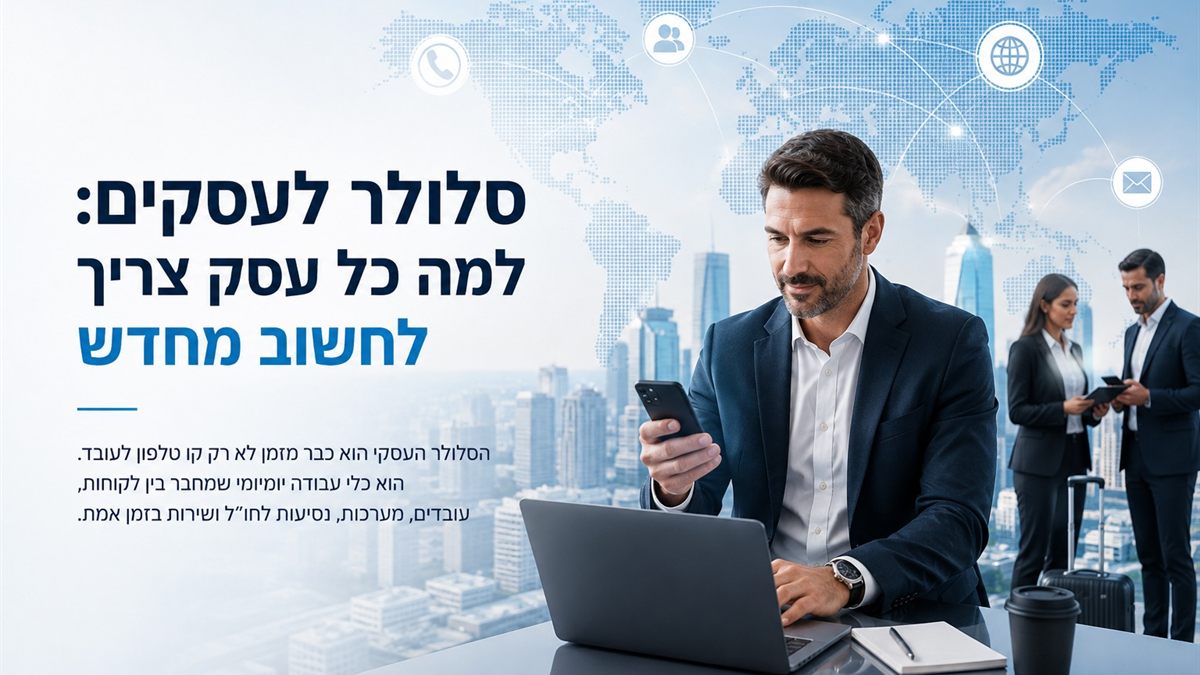
Business mobile stopped being just a phone line for an employee long ago. It's an everyday work tool that connects customers, employees, systems, trips abroad and real-time service.
In brief
Business mobile isn't just a monthly price per line — it's a work tool that affects employee availability, customer service, field work and the ability to stay connected on trips abroad. Businesses should check whether their mobile lines fit today's needs: eSIM, fast number porting, human service, an Israeli line that stays active abroad and a solution that suits employees in the field or on the road. Reviewing your business mobile can save money, improve availability and bring order to how the business manages its communications.
In recent years, the employee's mobile phone has become one of the most important work tools in the business. It's no longer used just for calls. It's connected to business WhatsApp, email, CRM systems, banking apps, SMS verification, video calls, customer service, task management — and in many cases to work outside Israel as well.
Even so, many businesses still treat their mobile lines as a routine monthly expense: they choose a package, connect employees, and from then on hardly ever check whether the solution really fits the business's needs.
But in a world where employees are out in the field, fly abroad, serve customers remotely and stay in constant contact with them — the right business mobile can make a big difference.
Business mobile isn't just a monthly price
When a business chooses a mobile provider, it's very easy to look only at price. How much does a line cost? How many gigabytes do you get? Are calls and messages included? These are important questions, but they aren't enough to tell whether the solution really fits the business.
In practice, price is only part of the picture. A business needs to ask broader questions — about employee availability, line management, trips abroad, service and the ability to get an answer when there's a real need.
- Are employees reachable when they're out of the office too?
- Can salespeople work continuously from the field?
- Does an employee flying abroad stay connected without hunting for temporary fixes?
- Can lines be ported without disrupting operations?
- Is there human service when you need help?
- Can the solution be tailored to a small, medium-sized or growing business?
Once you see business mobile as a work tool rather than just an expense, the choice changes.
Employee availability directly affects customer service
In a small or medium-sized business, every unanswered call could be a customer who went to a competitor. Every message not received on time can delay handling. Every employee who can't get online during a meeting, a trip or a day in the field can break the flow of work.
That's why employees' mobile lines need to fit the nature of the business. A business with field staff doesn't need the same solution as a small office. A company whose employees fly abroad needs to think differently from one that operates only in Israel.
A business that deals with customers via WhatsApp, SMS and calls must make sure its numbers are stable, reachable and easy to manage. The point is simple: good business mobile should support the work, not get in its way.
What happens when employees fly abroad?
One of the biggest challenges for businesses is communication during business trips. A manager, salesperson, technician, consultant or business owner flying to a meeting abroad still needs to be reachable for customers, employees and suppliers in Israel.
That's usually where the problems start: expensive abroad packages, buying a local SIM, changing numbers, trouble receiving SMS, not being reachable on WhatsApp or depending on whatever Wi-Fi happens to be around.
For a business, unreliable communication abroad isn't just an inconvenience. It can become an operational risk.
An Israeli line that stays active abroad lets the employee keep receiving calls, messages and verifications, and maintain continuity of work even outside Israel. For businesses with international activity, this is no longer a luxury — it's a real need.
eSIM is changing the way businesses manage lines
eSIM technology lets you activate a mobile line without a physical SIM card. Instead of waiting for a card to be shipped, handed over or replaced, a line can be activated digitally and faster — depending on device support.
For businesses, the advantage is clear: less logistics, less hassle, less dependence on physical cards, and the ability to respond quickly to new employees or employees about to travel.
Instead of managing a stock of SIM cards, tracking who got which card or dealing with replacements — the business can move to a simpler, more flexible solution.
Number porting doesn't have to be complicated
One of the things that keeps businesses from switching mobile providers is fear of porting. Business owners worry that lines will stop working, that employees will be stuck without service, or that the process will take too much effort.
In practice, when you work with a provider that knows the process and guides the customer through it, porting can be much simpler and faster than you think.
- Prepare an organised list of the business's active lines
- Check who uses each line
- Make sure the numbers are registered correctly
- Understand which employees need a standard solution in Israel
- Identify which employees also need a solution for abroad
- Coordinate the porting process with a provider that supports the business
An organised process prevents glitches and confusion, and lets the business switch more smoothly.
How do you know it's time to review your business mobile?
There are a few signs that it's worth stopping to review your current mobile solution. Sometimes the business has grown, the employees have changed and the nature of the work has evolved — but the mobile solution has stayed exactly as it was.
- If the monthly invoice isn't clear
- If there are active lines that nobody really uses
- If employees who fly abroad buy their own solutions on every trip
- If there are complaints about reception, data or availability
- If you don't have a human contact person when you need help
- If the business has grown but the mobile solution has stayed the same
- If you don't know exactly how many lines you have and what each one includes
In cases like these, a fresh review can save money, improve availability and bring order to how the business manages its communications.
What should you check before choosing a mobile provider for your business?
Before deciding on a mobile provider for your business, it's worth checking a few key points. The goal isn't just to find a well-priced package, but to choose a solution that fits the business's daily work, its employees, the field, growth and trips abroad.
- Is eSIM available?
- Can porting be done quickly and simply?
- Is there a solution for employees who fly abroad too?
- Is the Israeli line kept outside Israel too?
- Is there human, available service?
- Can you choose a network that suits the business's needs?
- Are the packages flexible and suited to the number of lines in the business?
- Does the provider understand business needs, not just those of private customers?
The clearer the answers, the easier it is to choose a mobile solution that really fits the business.
Comparison: standard business mobile vs. a solution built for a modern business
| Topic | Basic business mobile | Modern business mobile solution |
|---|---|---|
| Main focus | Monthly price per line | A work tool for employees and the business |
| Line management | Basic and sometimes disorganised | Clear management by employee and needs |
| eSIM | Not always available | Enables digital, flexible activation |
| Porting | May be seen as complicated | An organised, guided process |
| Employees abroad | One-off fixes on every trip | A built-in solution for employees who fly |
| Service | Not always personal | Human, available service |
| Fit to the business | A generic package | Matched to the nature of the activity and growth |
| Control | Partial | Clearer and more convenient |
In summary: your business mobile is part of your business's ability to work
Your business mobile isn't just another line item on the invoice. It's part of the business's ability to serve customers, sell, manage employees, work in the field, fly abroad and stay reachable at every important moment.
A business that chooses its mobile solution wisely gains more control, more flexibility, less hassle and more operational peace of mind.
If it's time for you too to put your business's mobile lines in order, look into porting, activate eSIM or find a solution that suits employees in Israel and abroad — Neptucom is here to help.
Want to find out which mobile solution suits your business?
Contact Neptucom and we'll help you choose a plan that suits the needs of your business, your employees and their trips abroad.
A Neptucom business sales representative will get back to you with a quote tailored to your business's needs.Frequently asked questions
Why is business mobile more than a phone line for an employee?
Because today an employee's mobile line is connected to email, WhatsApp, management systems, SMS verification, customer service, video calls and sometimes work outside Israel too. So it's an everyday work tool, not just a line for calls.
When should a business review its mobile lines?
It's worth reviewing when the invoice isn't clear, there are lines nobody uses, employees complain about availability or data, employees buy their own solutions abroad, or when the business has grown and the current solution no longer fits.
What's the advantage of eSIM for businesses?
eSIM lets you activate a mobile line digitally, without a physical SIM card, depending on device support. For businesses this can reduce logistics, shorten processes and make it easier to activate lines for new employees or employees who travel.
Does business number porting have to be complicated?
Not necessarily. When you prepare an organised list of lines in advance and work with a provider that guides you through the process, porting can be simpler and faster. At Neptucom you get a simple, fast porting process of about 15 minutes.
What should you check with a business mobile provider?
Check for eSIM availability, simple porting, a solution for employees who fly abroad, human and available service, choice of a suitable network, flexibility in the number of lines and an understanding of business needs.
Why does a mobile solution for abroad matter to businesses?
Employees who fly abroad still need to be reachable for customers, suppliers and employees in Israel. A mobile solution suited to abroad helps maintain continuity of work, incoming SMS, data and availability outside Israel too.